DIPr Lab to Appear at WiSec 2026
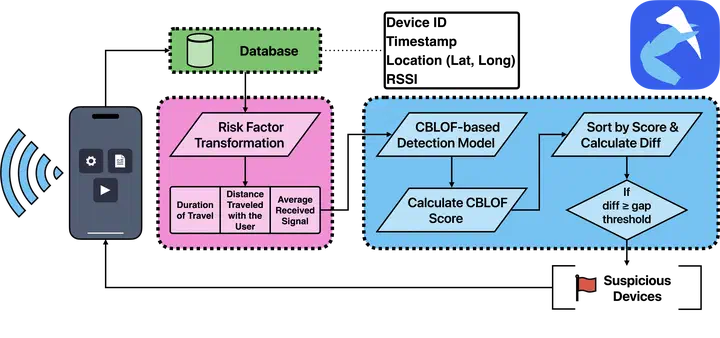 Architecture of BL(u)E CRAB with CBLOF Detection Model
Orobosa Ekhator’s paper and accompanying artifact have been accepted to the 19th ACM Conference on Security and Privacy in Wireless and Mobile Networks (WiSec) 2026. WiSec 2026 takes place on June 30th - July 3rd 2026 in Saarbrücken, Germany.
This paper introduces a detection model to identify suspicious devices using Cluster-Based Local Outlier Factor (CBLOF). CBLOF is an unsupervised machine learning model that clusters together similar types of data based on the data’s features, allowing it to identify anomalous values in the dataset based on how much of an outlier the value is within its cluster, or how abnormal the the cluster size is with repect to the other clusters.
The detection model takes the following parameters:
- k: the number of clusters to be created
- delta: the gap threshold
- alpha: used to determine the large cluster
- beta: used to determine large drops in size between consecutive clusters
The CBLOF detection model outperformed the baseline BLE-Doubt classifier, achieving a higher F1 score and better precision that BLE-Doubt, as well as slightly improved recall. CBLOF also had less false positive (non-suspicious devices that were incorrectly classified as suspicious) and slightly less false negatives (suspicious devices that were incorrectly classified as non-suspicious).
| TP | FP | TN | FN | Precision | Recall | F1 Score | |
|---|---|---|---|---|---|---|---|
| BLE-Doubt | 47 | 13 | 12135 | 10 | 0.78 | 0.83 | 0.80 |
| CBLOF | 49 | 3 | 12145 | 8 | 0.94 | 0.86 | 0.89 |
The full paper will be made available here.